Measuring the Return Journey: A Round-Trip Standard for Community Diagnostics
Access to diagnostics is often described in the language of geography. A service is said to improve access when it moves closer to patients: a mobile unit parked outside a village hall, a phlebotomy session in a community centre, an outreach clinic attached to a library. These are welcome developments. But distance is only the first leg of a longer journey. For a diagnostic test to count as accessible, the patient must be offered it, able to reach it, able to provide a sample that survives the journey to the laboratory, and able to receive a result that someone acts on. Access is not a point on a map. It is a round trip.
From catchment to circuit
Hospital catchments describe where patients are expected to travel. Community diagnostics describes something more ambitious: bringing the test closer to where people live and work. The two models are not interchangeable. A mobile unit is not a small hospital on wheels. It depends on schedules, venue suitability, privacy, power, connectivity, trained staff and a sample transport route that respects the stability limits of each test.
A village hall can be an excellent setting for a blood test. It can also introduce new failure points. Is there a private room? Is the entrance step-free? Can someone arrive by public transport and wait indoors? Does the session run at a time that suits shift workers and carers? Is the appointment offered through the usual booking route, or does it require a smartphone and a fast broadband connection? These questions are not administrative details. They determine whether the offer becomes an appointment and whether the appointment becomes a usable result.
The round-trip standard asks services to map the entire circuit rather than the outward leg. That circuit begins with how the test is offered and ends with what happens after the result is reviewed. In between sit travel, waiting, phlebotomy, labelling, transport, laboratory acceptance, reporting, interpretation, communication and, where needed, repeat testing. Each transition is a chance for the patient to fall out of the loop.
The sample has a journey too
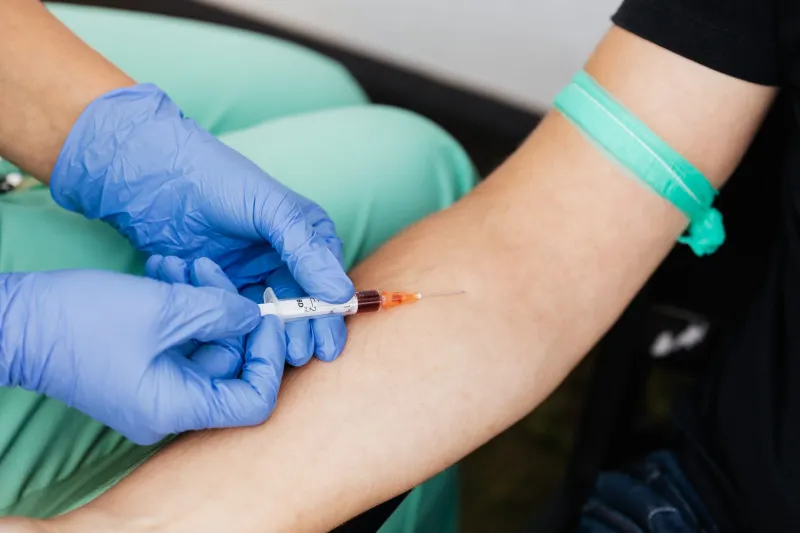
Community diagnostics often depends on moving samples rather than moving patients. That is sensible, but it places the pre-analytical phase under pressure. Blood samples have stability windows. Some tests tolerate a few hours at ambient temperature; others need specific handling, timely separation or controlled conditions. A mobile unit that collects samples at 10am but joins a courier route at 4pm may be clinically convenient and analytically unsafe.
Commissioners should therefore ask for validation that follows the sample, not just the patient. Has the transport route been tested for each assay offered? Are seasonal temperatures considered, including summer heat and winter delays? Are tubes labelled and documented to the same standard as in a hospital phlebotomy service? Does the laboratory know which sites are feeding into which runs? Is there a failsafe for samples that arrive outside the acceptance window?
These are not reasons to avoid outreach. They are reasons to design it around the laboratory's real constraints. A community service that cannot guarantee sample integrity is not improving access; it is redistributing risk.
Who falls out of the loop
The patients most likely to benefit from outreach are also the patients most likely to be lost between visits. They include older people with frailty, people without a car in rural areas, carers with limited time, shift workers, people with learning disabilities or mental health needs, and households where English is not the first language. A single visit to a village hall may remove one barrier while leaving several others intact.
Repeat testing deserves particular attention. An abnormal result often requires a repeat sample, and a repeat sample often requires another journey. If the outreach service has moved on, the patient may be left to arrange a hospital appointment that was the original problem. A service that screens or tests without a plan for recall is incomplete. The same applies to results that need urgent review: the community setting must have a named clinical owner and a route into the usual record, not a separate inbox that is checked intermittently.
Continuity matters more than novelty. Patients need to know who will contact them, how, and by when. Practices need to know which results belong to them. If a mobile provider holds the result, the practice may not see it. If the practice holds it, the provider may not know whether action was taken. The round trip is only complete when responsibility is clear at every handover.
A practical checklist for commissioners and practice teams
Before adopting or renewing any outreach diagnostic service, the following questions should have documented answers:
- Is the test offered through usual care channels, with a clear referral route and an entry in the patient record?
- Does the service measure the whole round trip, including travel, waiting, appointment time, sample transport and repeat testing?
- Has sample stability been validated for each site, season and transport route?
- Is there a named clinical owner for results, with a failsafe for results that are not reviewed?
- Do IT systems interoperate with general practice and the pathology network, or will results sit in a separate silo?
- Are venues accessible, private and reachable by public transport, and are interpreters or easy-read materials available?
- Is there capacity for repeat testing, recall and safety-netting, not just first appointments?
- Are outcomes measured beyond activity, including samples rejected, results acted on, repeats completed and patients lost to follow-up?
- Is there a plan for missed appointments and for patients who do not re-engage?
- Is the service sustainable beyond a pilot, with recurrent funding and a clear exit or handover plan?
Measuring what matters
Activity figures such as tests performed or appointments filled are useful for management, but they do not demonstrate access. A more honest set of measures includes the interval from offer to attendance, the proportion of samples accepted by the laboratory, the time from sample to result, the time from result to clinical action, and the proportion of required repeats completed. These measures should be broken down by age, deprivation, rurality and ethnicity where data allow. Equity is not an add-on to access; it is the test of whether access is real.
The van, the village hall and the blood sample are not endpoints. They are stages in a chain that patients experience as a single episode of care. Diagnostic access should be judged by whether that episode ends with a result that someone explains and acts on, and whether the patient who needs a repeat can get one without starting the journey again. That is the standard worth commissioning against.